

The 2025 Edition of the PM² Project Management Methodology refines how projects are understood, planned and managed while retaining the methodology’s simplicity. The key updates include clarifications on the distinction between business and implementation objectives and responsibilities, while improving consistency across the PM² methodologies suite.
Projects as organisational investments
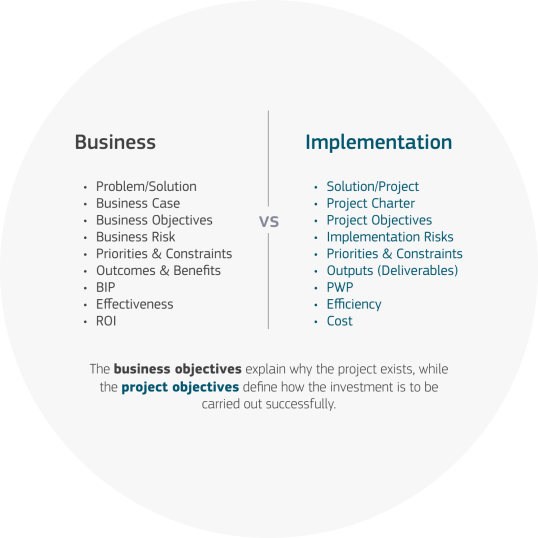
The updated model emphasises that projects are organisational investments. An organisation commits time, money, resources and management attention in the expectation of achieving specific results. The guide sharpens the distinction between the business objectives that justify this investment and the project objectives that guide its implementation.
The business case explains why the investment is justified and what it is expected to achieve. Project objectives translate that intention into an agreed scope, timeframe, budget and level of quality.
Project management must therefore support delivery against all four objectives: scope, time, cost and quality. Time, cost and quality are treated as objectives in their own right, rather than merely as constraints on delivering the scope.
This perspective provides a more precise basis for assessing project success. Completing the agreed scope fulfils only part of the commitment: delivery must also meet the approved time, cost and quality objectives. Their relative importance may vary, so trade-offs should reflect agreed priorities and guide governance decisions.
Clearer business and implementation risks and responsibilities
The distinction between business and implementation also applies to risk. Business risks affect the likelihood of achieving the intended business objectives, while implementation risks affect the achievement of project objectives. Clarifying their respective ownership helps ensure that both receive appropriate attention and that decisions addressing their interdependencies remain coordinated.
This reinforces collaboration between the business and solution provider sides, keeping implementation connected to the purpose that justified the investment.
Explicit management objectives for every phase
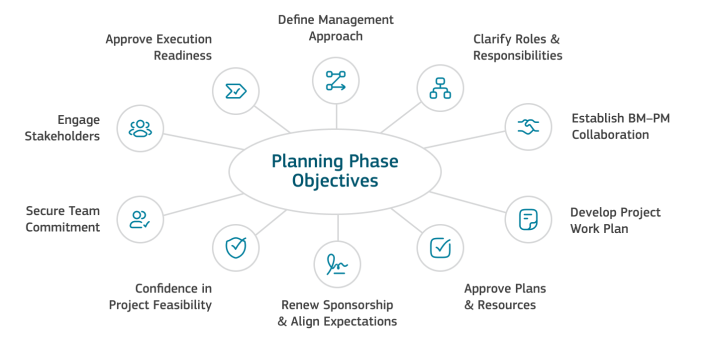
The guide gives greater prominence to phase objectives, alongside activities and management artefacts. Teams can assess whether a phase has achieved its purpose, rather than relying solely on whether its documents have been completed. This provides a clearer basis for readiness assessments and decisions to proceed to the next phase.
Monitor and Control activities have also been regrouped, combining several activities and reducing their total number by one. The revised grouping makes the management work easier to navigate and apply coherently.
A more consistent and accessible suite
The updated guide aligns terminology, models, common processes and presentation with the programme and portfolio management publications. It also follows European Commission accessibility guidelines, making the content more accessible to a wider range of users.
Together, these refinements support consistent application across the PM² suite. They preserve the methodology’s established foundations while making objectives, responsibilities and decision points clearer.
- Publication date
- 26 November 2026
- Author
- Directorate-General for Digital Services